
Food bank expands services to meet the needs of vulnerable people in the North York Region amid global pandemic.
 Jane & Finch
Since COVID-19, food bank usage has skyrocketed. Located at Steeles & The 400, ANIDA’s Food Bank user base has increased by 400% since March. This surge in demand is likely a result of several food bank closures in the area as well as pandemic related job losses.
A recent report released by The Daily Bread Food Bank found that among new clients, 76% began accessing food banks as a result of COVID-19 and the associated economic downturn.
But what about those who can’t make it to a food bank?
When ANIDA made the decision to keep its doors open during the pandemic, we started receiving phone calls from clients who were not able to physically come to the food bank due to health and mobility concerns.
Thus, began a partnership with a Toronto Community Housing seniors building in the Jane & Finch area.
Every other week, ANIDA delivers grocery bags to residents of the building, containing basics such as milk, veggie burgers, fresh produce, non-perishables, and bread from Cobs Bakery.
 Unloading Bags of Groceries at the TCHC Building
The program began with a list of 40 clients. Now we are delivering over 200+ bags of groceries to 110 seniors in the building.
One 73-year-old resident who goes by the name “Stella” has been coming to ANIDA’s Food Bank for several years. Since receiving surgery to treat a medical condition, Stella has been in self-quarantine and is unable to make the trip to ANIDA’s Food Bank.
Stella is not alone in her struggles to get groceries during the pandemic.
“A lot of people rely on [ANIDA’s] service because they are very old, some are 83 and 85 years old,” Stella said.
Another tenant, Isabelle*, has lived at the building for 8 years. She is very grateful for the convenience that delivery offers during this difficult time.
“Most of us are disabled, so delivery is much better. Especially when you are trying to carry back canned goods,” she said.
Isabelle has played a major role in growing the program, calling in and registering other tenants who did not have access to a phone or computer. She is a proud advocate for the partnership and has felt its impact first-hand.
“The biggest impact of the delivery program is that it makes us feel really cared for,” Isabelle said. “Not only are you giving us food, but you are bringing it to our door. It’s like waiting for a Christmas package. It’s wonderful to open a box and get soups, cheese, fresh rolls of bread and often treats like dark chocolate”
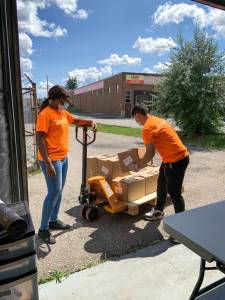 Loading boxes for delivery
Joseph Greer is a Community Services Coordinator at Toronto Community Housing Corporation (TCHC). He manages 29 TCHC buildings and meets twice a month with tenants to understand their needs and address concerns. Echoing the sentiments of Isabelle, Greer noted the holistic nature of the program’s impact, not only in terms of food security, but in disrupting social isolation.
“The delivery of essential food has been beyond just food — it’s the whole social wellness aspect, it’s safety, it’s helping with isolation,” said Greer.
“Many folks don’t get visitors. The food program has not only been essential for food and nutrition but also helps with mental health and breaking social isolation. It is confirmation that the community cares about the wellness of the tenant population. It runs far deeper than a meal. It is the love and the care behind it.”
*A pseudonym has been used for client privacy reasons.